
Personal Stories
Don’t Tell Anyone About the Smoke
Attention, attention! A young chef lights a fire, literally and figuratively, while learning how to season life the Estonian way.
Smoke was everywhere. For a second, I thought we are in a Turkish bath? Our interviewee was from Turkey, after all. But he was just trying, once again, to get the fireplace going properly. The smoke quickly filled the spacious, chilly room, which became even colder a few moments later, when we had to throw the doors wide open, letting in the sharp air and releasing the bitter scent of burning wood.
No blankets, no hot tea, but the conversation kept us warm.
We sat there trembling and smiling, gathered around the fireplace. The interview began to feel less like work and more like visiting a friend who insists you stay until the room warms up.
Spoiler: it wouldn’t.
This was our second meeting with Ramazan Inalhan. The first time we met was as part of the project Integration and Adaptation Support in Haapsalu during the event Café of Encounters – Stories from the World, where the guest speaker was Cees from the Netherlands. Cees talked about Dutch food, culture, and traditions. After the event, I offered Ramazan to become a part of our project, and he said yes really quickly without any doubts.
And here we are, sitting on a smoky, half-cold terrace, making jokes about marriage and talking with all passion that we have about food, of course.
Funny, honest and kind. He learned quickly that “Turkish” on a sign creates certain expectations.
“If I open a Turkish restaurant and there’s no kebab or döner, people will be disappointed,” he said. “There are classic recipes you just don’t skip.”
Still, he keeps a second track in mind, that is a quieter, Estonian-facing plate. The trick is spice. His favorite heat comes from the east of Turkey: chilies boiled, dried, and flaked, often with roots in Aleppo.
“It’s special,” he said, “but here I use it carefully. Estonians usually say, ‘Oh, it’s spicy!’ even when I barely add it.”
He isn’t annoyed, he’s interested. For every dish, he dials salt, sour, and heat like a sound engineer, trying to make the flavor “sound right in this room.”
Tastes shift with place. “Since I came to Estonia, I eat less salt, fewer spices. My own logic changed,” he admitted.
Still, there’s one dish he’s itching to serve when he opens: slow-braised lamb shank with mashed potatoes and a red-wine sauce — rich, careful, comforting.
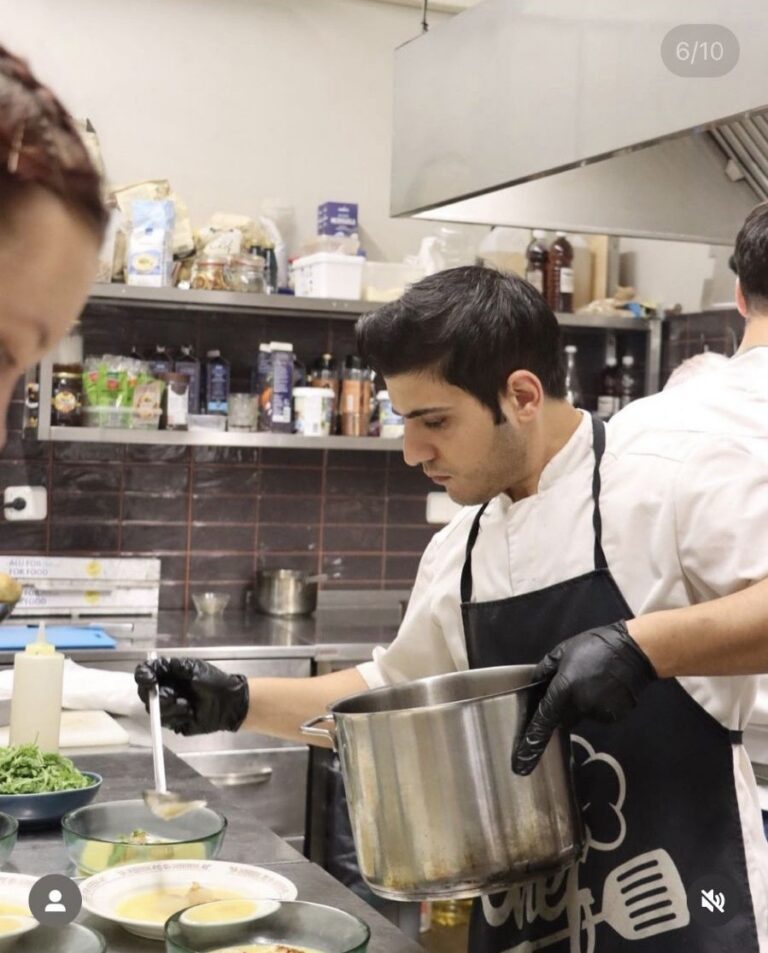
And his role? Not “the boss.”
“I want to be the main person in the kitchen, not a guy giving orders,” he said. “Come in the morning, cook, talk to people, go home, come back tomorrow. No drama. Just work. Every month, every year improve a little. Better Turkish cuisine for this place.”
Restaurants run in the family. His father worked two decades in Istanbul, his brother has been running his own place for fifteen years. “Among the brothers, only two of us are chefs,” he smiled.
“So if my brother has a restaurant and I don’t, then shame on me. I should have one too.”

The funniest thread in his story is his mother — strict about the kitchen and famously stingy with recipes.
“She never let me cook. Even now, I go in just for water,” he laughed. When he brings his own food home, she tastes it, pauses, and delivers the verdict: “Salt is missing. Black pepper is missing.” Maybe she likes it, maybe she just won’t say. Either way, the family joke stands:
„Some recipes are harder to steal than gold.”
When asked what he likes about Estonian cuisine, he didn’t hesitate.
“Black bread,” he said immediately, almost ceremonially. “They make soup with it, sweets with it — everything with black bread! I like it.”
Then, to everyone’s surprise: “And blood sausage.”
He laughed at my raised eyebrows. “Yes! With potatoes and butter. That’s the best combination. You know, at first I thought, no way. But now? Delicious.”
He talks about Estonian fish the way poets talk about sunsets. “Baltic fish is really good: cod, perch. Especially when you make cutlets. They’re juicy, fatty, perfect.”
He plans to keep them on his future menu in Turkey. “Same fish, different sea,” he said, grinning. “We can share them.”
He and his wife live in a small town near Haapsalu, quiet and green, the kind of place where everyone knows whose cat is visiting which garden. “In Istanbul, there were millions of people,” he said. “Here, maybe two thousand. Perfect. Fewer people, less noise — my dream!”
The plan is flexible: half the year in Estonia, half in Turkey. “Summer here is wonderful – twenty degrees. But winter… too dark.”
Their daughter, now two, already speaks Estonian and teaches her dad.
“She goes to kindergarten in a small group with only ten kids,” he said proudly. “Sometimes she doesn’t want to come home. She cries because she wants to play more. That makes me so happy. It means she belongs here. But in the mornings, she doesn’t want to go, of course. Like every normal kid.”
He leaned back, suddenly serious but only for a moment.
“Education here? I love it. It’s free. In Turkey, kindergarten for one year can cost thirty thousand euros! I was shocked. I thought, are they teaching philosophy or babysitting?”
Then he laughed again. “And in Turkey, we have another habit — we go to the doctor for everything. Headache? Doctor. Finger hurts? Doctor. My mom once went because her hand felt strange. Maybe it was just air conditioning.”
He grinned. “Here, they send you to the pharmacy first. I like that! You get your pill, go home, and you’re fine. No drama, no hospital selfies.”
He laughed when I asked if he missed the Turkish way of visiting friends, neighbors, cousins — everyone, every day.
“In Turkey, we’re too social,” he said. “My mom goes to my sister’s house, my uncle’s house, my brother’s restaurant… she even visits my brother’s employees at their homes! She knows their families! I think she has more social life than the internet.”
So what about Estonia, I asked — all that quiet, all that space?
He grinned. “I like it. I really do.”

„In Estonia, people are like ice. You have to melt them first. But once you do, they stay warm for a long time.””
He told me how it took three years before he and a local friend really started talking. “We met in a Greek restaurant. After three years — finally, conversation!” he laughed. “But it’s good like that. In Turkey, you say hi and suddenly you’re best friends. Here, people need distance. And I respect that.”
Then he confessed something that made both of us laugh out loud. “When I lived in Turkey, before going outside my apartment, I always checked through the peephole. If I saw a neighbor, I waited until they left. Because if they saw me, there would be questions like ‘How are you? How is life? Did you sell your car?’ And I thought, why do you even know about my car?”
He shrugged, still smiling. “So maybe I’m a little Estonian now.”

When the restaurant closes and his daughter finally falls asleep, his second life begins — the quiet one.
“I’ve had ADHD (Attention deficit hyperactivity disorder) since childhood,” he said. “I can’t stop. I always need to move. But when I read, I freeze. It’s like hypnosis.”
He laughed, shaking his head. “Sometimes I sit reading from morning until night and forget to stand up. My back hurts, my legs go numb, but I don’t even notice. Books are more interesting than real life.”
Most nights, after everyone’s asleep, he still opens a book. “I know I’ll hate myself in the morning,” he grinned. “But I do it anyway. It’s peaceful. I feel like I’ve completed something.”
He reads everything from classics to economics, but his favorites are the ones that build entire worlds. “Tolkien of course. The Lord of the Rings, The Hobbit. But also The Fall of Númenor, not many people know it. He created languages, alphabets, races, histories. It’s imagination at full power. I love that.”
Detective novels, however, are another story. “I feel stupid when I read Agatha Christie,” he laughed. “Nothing I guess ever happens! I think, maybe my IQ is the same as a monkey’s.”
At home, cooking is both his job and his habit – but not always by choice.
“In the beginning, when we came to Estonia, my wife cooked for maybe two or three months,” he said. “Then one day she told me, ‘You know, you cook better than me.’ And that was it. My fate was sealed.”
He laughed the laugh of a man who has accepted his destiny. “So now I cook at work and at home. We have a deal: I cook, she washes the dishes. But after dinner, she says, ‘You take care of the child, I’ll wash later.’ And then… she never does. I told her next time, I’m not cooking. She just smiles.”
„That’s marriage.”
Evenings often end with Netflix debates. “We have different tastes,” he dmitted. “She loves those long crime, love, drama series. I prefer movies. But we’re married, so of course, we watch what she wants.” He grinned. “And when she falls asleep, I finally watch what I want.”
That balance of soft arguments, small jokes, quiet understanding is what he calls real peace.
“When I was younger,” he said, “I was always out with friends, talking about politics, philosophy, drinking coffee at midnight. Now I just want stability. To know my wife and daughter are home, to go to sleep at twelve, wake up early, cook, work, come back. That’s happiness for me.”
He smiled when I asked if he was a happy person. “Depends where I am,” he said. “Here yes. In Turkey less.”
He explained it with that same dry honesty that runs through all his stories. “In Turkey, my mom would visit my house every day. ‘Why is your house dirty? Why isn’t your child home by five? Why didn’t you wash this?’” He laughed, shaking his head.
“Now, in Estonia, no one tells me what to do. I’m the boss of my own life. Finally.”
For him, happiness isn’t luxury, it’s calm. “When I was younger, marriage sounded like a prison. But that was just what people around me said. After I married, I realized – no, it’s freedom. Real freedom. Because it’s trust, not a cage.”
He’s been married five years now, four of them with a child, and he calls it “the best part of growing up.”
“I never had long relationships before. The longest was three months!” he laughed. “Now I have a wife, a daughter, and peace. That’s my success story.”
When I asked what he loves most about living in Estonia, his answer was quick and sincere: “The quiet. The air. The space.”
He thought for a second, then added, “And that feeling when I wake up in our small town, it’s quiet, just birds and trees. No traffic, no horns, no stress. It’s like the world takes a deep breath before it starts the day.”

Then he looked toward the half-burned wood in the stove, the smoke curling lazily toward the ceiling, and smiled. “In the end,” he said…
“I don’t need much. Just one good place that’s mine, where I can cook, laugh, and live.”
By the end of our talk, the smoke had finally found its way out. Probably to tell the neighbors there’s a new chef in town. He waved from the doorway, smiling, smelling faintly of firewood and black bread.
Somewhere between Turkey and Estonia, between spice and silence, he’d built himself a life, a place where even smoke can taste like a dream that went slightly off recipe, but still turned out just right.
“Don’t tell anyone about the smoke,” he could have said. But he didn’t need to, he already knew I would.